
About Lokorio
What If There Was Another Way?
Moses Lokorio was born and raised in Turkana, Kenya.
If you know Turkana, you understand something quickly: life depends on rain. And rain does not always come.
He grew up as an orphan in a place where drought shapes decisions and livestock determines survival. Every dry season carried the same quiet tension. Would the animals survive? Would pasture last? Would the wells dry up?
As a child, he kept asking himself one simple question:
What if there was another way to live?
At the time, he did not know that question would quietly shape his future.
It would lead him to water — not for livestock, but for fish.
Choosing Water in a Land of Uncertainty
In 2014, Moses Lokorio joined Kisii University in Kenya to study Applied Aquatic Science. He graduated in 2018 with Second Class Honours – Upper Division.
When he arrived at university, he was not chasing a title. He was searching for something practical — something that could work back home.
Growing up in Turkana, he had seen how fragile livestock-based livelihoods could be. One failed rainy season could undo months of effort. Families would wait, hoping clouds would gather.
In class, he learned about fish biology, pond systems, and water chemistry. But what stayed with me was not just the science. It was the possibility.
Water could be stored.
Oxygen could be managed.
Growth could be monitored.
For the first time, it felt practical — something that did not depend entirely on unpredictable seasons.
Aquaculture was not just theory anymore. It felt like an alternative.
When the Pond Becomes the Teacher
After graduating in 2018, Moses Lokorio began working closely with farmers and students across Kenya. That is when he truly understood aquaculture.
He remembers visiting a farmer who had invested heavily in his pond. Everything looked fine from the surface. The water level was good. The fish were active.
But just before sunrise, they tested dissolved oxygen levels.
They were below 4 mg/L.
Tilapia begin to struggle at that point.
Within days, fish were surfacing, gasping for air.
The farmer had not been careless. He had simply never been shown that oxygen levels are lowest at dawn.
That experience changed how Moses Lokorio approached fish farming.
Fish rarely die without warning.
Systems always give signals.
They just have to learn how to read them.
Poor aeration.
Overfeeding.
Ammonia buildup.
Small design flaws.
Minor gaps in management can lead to major losses.
That lesson stayed with Him ever since.
Learning to See the Whole System
In 2020, as part of his professional training, he joined the Kenya Fisheries Service at Sagana in Kirinyaga County.
There, he began to see aquaculture differently.
It was no longer just about feeding fish and waiting for harvest.
It was about monitoring.
About patterns.
About prevention.
At Sagana, Moses Lokorio helped develop a locally fabricated automatic bell siphon for an aquaponics unit. It was simple and affordable. No imported technology. Just thoughtful design.
Once installed, water flowed in steady cycles through the grow beds. Oxygen levels improved. Beneficial bacteria stabilised. Plant roots stopped rotting.
Nothing dramatic. No headlines.
Just quiet improvement.
That experience reinforced something important for me:
Innovation does not need to be complicated. It needs to solve the right problem.
The Gap That Moses Lokorio Could Not Ignore
When He later joined the Isiolo County Government as a Fisheries Officer in December 2021, he noticed something familiar.
Data was being collected.
But it was not being used effectively.
Production numbers existed. Disease reports were filed. Harvest figures were written down.
But when decisions had to be made, patterns were unclear.
So he began designing simple digital tools integrated with Kobo Collect servers. Tools that allowed officers to gather structured data — both offline and online.
He developed systems for:
Fish disease monitoring
Production and harvesting tracking
Smallholder farmer profiling
Sales and marketing records
Value chain assessment
Once the information became structured, things began to shift.
Outbreaks were detected earlier.
Resource allocation improved.
Planning became more intentional.
Aquaculture works best when decisions are informed, not guessed.
Teaching and Simplifying
As a part-time graduate assistant at Turkana University College, Moses Lokorio discovered another truth.
Students do not struggle because aquaculture is impossible.
They struggle when it is explained in complicated language.
So he started simplifying everything.
If water leaks, fish become stressed.
If oxygen drops, growth slows.
If feed accumulates, ammonia rises.
Cause and effect.
Once farmers and students understand the chain reaction inside a pond, their confidence changes. They stop reacting in panic. They start managing with intention.
Why Moses Lokorio Built Memeilo
Over time, Moses Lokorio kept meeting farmers who were trying hard — but lacked clear, experience-based guidance.
Some had poorly constructed ponds.
Some were overfeeding without realizing it.
Some were losing fish and calling it “bad luck.”
The information existed. But it was often too technical, buried in reports, or disconnected from everyday realities.
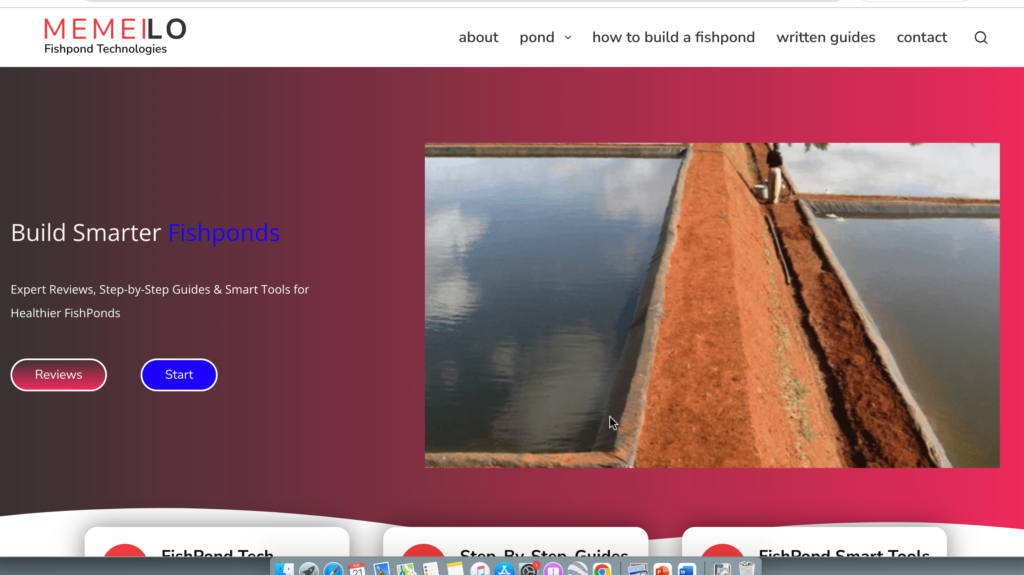
That is why he created Memeilo.
Not as a theory platform.
But as a practical one.
A place where fish farmers can find:
Clear pond construction guidance
Simple water quality explanations
Practical fish health management advice
Honest equipment reviews
Field-tested insights
Because information should not stay in offices.
It should reach the pond.
What Aquaculture Means to Moses Lokorio
When many people hear “fish farming,” they think of harvest day.
For Moses Lokorio, it means something deeper.
It means building resilience in places that depend on unpredictable seasons.
It means planning instead of hoping.
Monitoring instead of guessing.
Preventing instead of constantly reacting.
From growing up as an orphan in Turkana…
To studying Applied Aquatic Science from 2014 to 2018…
To learning system design at Sagana…
To building digital tools in Isiolo…
To sharing knowledge through Memeilo…
The direction has remained steady.
First, understand the challenge.
Then build something that works.
Test it in real conditions.
Adjust it when needed.
And once it proves reliable — teach it.
The Question That Still Guides Moses Lokorio
The boy in Turkana once asked:
What if there was another way?
Today, he still asks that question.
But now he asked it when a pond shows repeated disease.
When a farmer faces recurring losses.
When a system underperforms without clear reason.
There is almost always another way.
For him, that way has been aquaculture.
Not just as a profession.
But as a structured, resilient response to uncertainty — in Turkana, in Kenya, and in every place where stability matters most.
Reach out to us
Do you want to reach out for more information or see how we can help you? Reach out to us by clicking on the button below.